

An Industry at a Crossroads
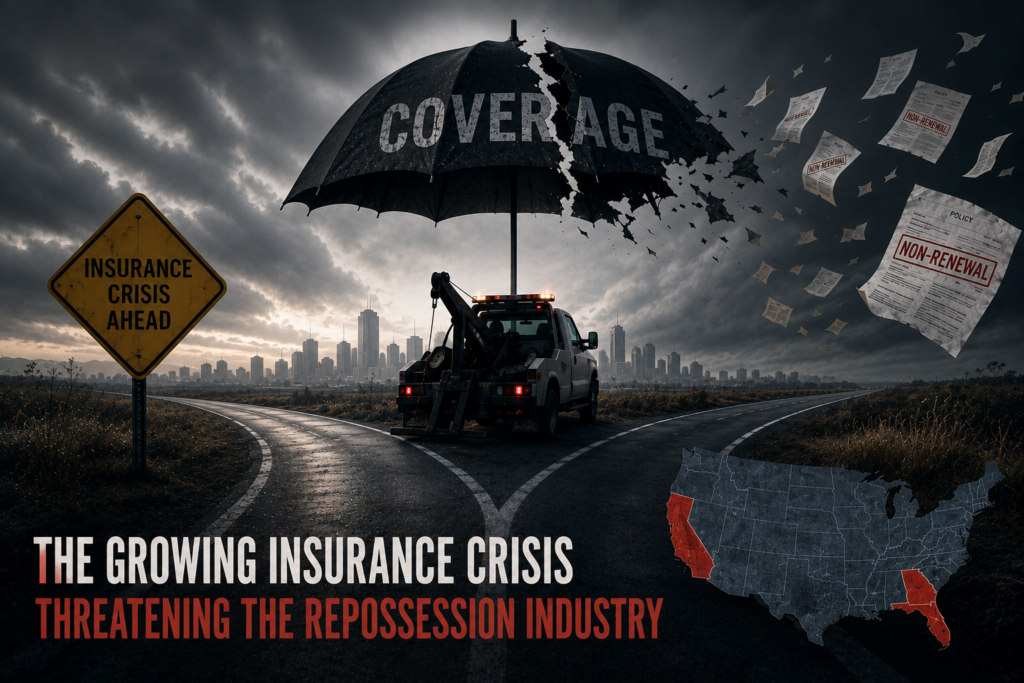
The Growing Insurance Crisis Threatening the Repossession Industry
GUEST EDITORIAL
A serious and largely unreported crisis is developing within the repossession industry. Across several states, insurance carriers that have traditionally provided coverage to repossession agencies are either exiting the market entirely or significantly restricting their exposure. As a result, many professional recovery agencies are finding themselves unable to obtain the insurance coverage required to legally and contractually operate.
The effects are already being felt in Georgia, California, and Florida. Unfortunately, industry leaders believe these challenges are only the beginning. Without meaningful intervention from insurers, regulators, and industry stakeholders, the problem is likely to spread nationwide.
The Insurance Availability Problem
For years, repossession agencies have operated in an increasingly complex environment. Rising litigation, larger claim settlements, social inflation, regulatory scrutiny, and increased operating risks have all contributed to growing losses for insurance carriers.
In response, some insurers have chosen to reduce their participation in the repossession sector, while others have withdrawn altogether. For agency owners, the issue is not simply higher premiums. In many cases, coverage is unavailable regardless of cost.
Many agencies report receiving non-renewal notices with few or no alternative markets available. Others are being offered policies with significant coverage limitations, reduced limits, or premiums that make continued operations financially unsustainable.
A key factor in improving insurability is demonstrating a strong commitment to risk management. Every agency owner should have comprehensive written policies and procedures designed to protect the business, its employees, clients, and the public. These policies should not simply exist on paper—they should be followed consistently, incorporated into daily operations, regularly reviewed, and readily available to employees. Agencies should also provide documented training to ensure personnel understand and comply with established procedures.
A Threat to Business Continuity
Insurance is not optional in the repossession industry. Financial institutions, lenders, forwarders, and vehicle finance companies require agencies to maintain specific coverage levels as a condition of doing business.

Without insurance, an agency cannot legally or contractually perform recoveries for most clients.
As policies expire and replacement coverage becomes unavailable, agency owners are being forced into difficult decisions:
– Suspend operations until coverage can be secured.
– Reduce service areas and staffing.
– Sell or merge their businesses.
– Permanently close their doors.
For many small and mid-sized agencies, these outcomes threaten years or even decades of investment, employee development, and community relationships.
The Ripple Effect on Lenders and Clients
The impact extends far beyond repossession companies.
When agencies are forced to shut down or reduce operations, lenders lose critical recovery capacity. Recovery assignments become concentrated among fewer providers, creating bottlenecks and service delays.
Potential consequences include:
– Longer recovery times.
– Increased skip-tracing expenses.
– Higher loss severities.
– Reduced geographic coverage.
– Increased operational costs.
– Greater exposure to collateral depreciation.
In regions where multiple agencies lose coverage simultaneously, lenders may face significant disruptions in their recovery networks.
What begins as an insurance problem for a repossession company quickly becomes a portfolio performance problem for lenders and financial institutions.
Georgia, California, and Florida: Early Warning Signs
Several states are already experiencing the effects of insurance market contraction.
Georgia, California, and Florida have emerged as key examples where agency owners report increasing difficulty obtaining affordable and adequate coverage. These states may represent an early warning of what is coming elsewhere.
In Georgia specifically, at least one insurance broker has pointed to the state’s liability environment and the absence of a fixed statutory dollar cap on medical damages as a significant concern when evaluating potential bodily injury exposure. While Georgia enacted significant tort reform in 2025 that changed how medical expenses can be presented and valued in personal injury cases, those reforms did not establish a fixed dollar ceiling on the total medical damages that may ultimately be awarded.
From an underwriting standpoint, that can still leave insurers facing potentially significant and difficult-to-predict bodily injury exposure, particularly in industries such as repossession where claims can involve allegations of physical injury. As a result, some market participants view Georgia as a challenging jurisdiction when assessing long-term risk and pricing coverage.
For additional information regarding Georgia’s 2025 tort reform legislation, see: Gov. Kemp Signs Historic Legislation Delivering Commonsense, Meaningful Tort Reform | Governor Brian P. Kemp Office of the Governor.
Industry participants across the country should pay close attention. Historically, challenges that first emerge in a handful of states often expand nationally as insurers reevaluate risk and underwriting strategies.
The question is no longer whether the issue exists. The question is how quickly it will spread.
Why This Matters to Everyone
Repossession agencies serve a critical function within the consumer finance ecosystem. They help lenders manage risk, recover collateral, and maintain stability in vehicle lending markets.
If insurance availability continues to deteriorate, the industry could face a significant reduction in qualified service providers. The result would be fewer recovery agents, diminished competition, increased costs, and reduced service capacity nationwide.
Strong operational controls can help reduce claims frequency and severity. Risk assessment training should be a core component of every agency’s employee development program. Employees should be trained in situational awareness, conflict avoidance, scene evaluation, de-escalation techniques, and recognizing circumstances that may create unnecessary exposure. Proper risk assessment training can help prevent accidents, injuries, allegations of misconduct, breach of peace claims, and other liability events that negatively impact both agencies and insurers.
This is not simply an agency problem. It is an issue that affects lenders, finance companies, forwarders, vendors, employees, and ultimately consumers.
A Call for Industry Action
The repossession industry has successfully adapted to changing regulations, technology, compliance requirements, and economic conditions. The current insurance crisis, however, presents a unique challenge because it threatens the industry’s ability to operate at all.
Industry associations, lenders, insurers, and agency owners must work together to identify solutions. Those solutions may include expanded insurance market participation, alternative risk-sharing models, stronger industry loss-control programs, greater emphasis on written policies and procedures, enhanced employee training, risk assessment education, and greater awareness among clients regarding the challenges agencies face.
Agency owners who invest in documented policies, consistent compliance practices, ongoing training, and proactive risk management place themselves in a stronger position to protect their businesses and demonstrate to insurers that they are committed to reducing losses.
Without action, more agencies will lose coverage, more businesses will close, and recovery networks will become increasingly strained.
The warning signs are already visible in Georgia, California, and Florida.
The rest of the country should pay attention. This crisis may be coming to a state near you.
The Growing Insurance Crisis Threatening the Repossession Industry – The Growing Insurance Crisis Threatening the Repossession Industry – The Growing Insurance Crisis Threatening the Repossession Industry
Sincerely,
Gerri H.Gentry
Managing Member
Premier Recovery
President, Recovery Agents of the Carolinas (RAC)
And
Emily Hemmings
President, Quick Recovery Services
and President, Georgia Association of Licensed Repossessors (GALR)
The Growing Insurance Crisis Threatening the Repossession Industry – Repossess – Repossession – Repossession Agency – Repossessor – Repossession – Compliance






More Stories
When “Partner” Is Just Another Word for Vendor
Welcome to the Repossession Casino — But Who Is Really Paying the Losing Bets?
The Cost of Doing Business: Why We Cannot Afford to Work for Free
The Insurance Barrier: When Tow and Repo Try to Cross the Line
Everyone Wants a Safe Repossession. Nobody Wants to Pay for One
The Industry We Built and the Standards We Must Protect