

There has been a growing misunderstanding within the repossession industry regarding the proper definition, use, and cost implications of dollies and flatbed (rollback) wreckers. As state association leaders, we are coming together to provide clarity and consistency on this subject to protect the safety, compliance, and operational integrity of the repossession community nationwide.
Defining the Difference: Rollback vs. Dollies
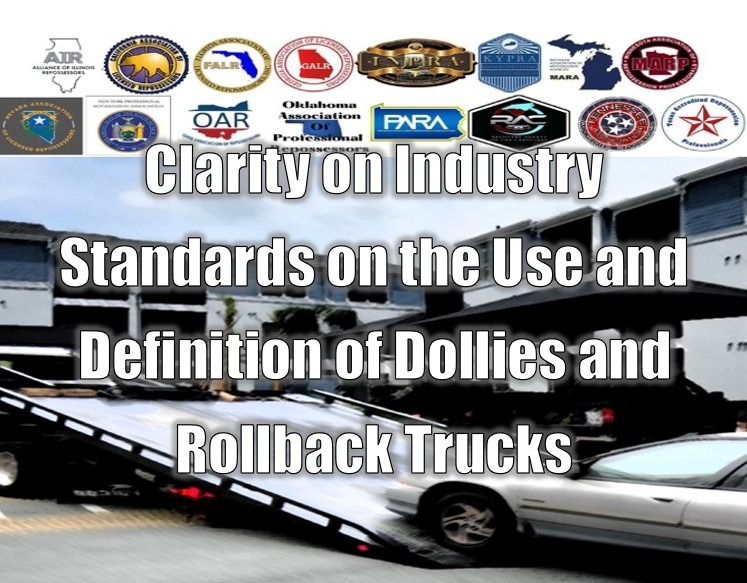
A flatbed wrecker, commonly referred to as a rollback, is a specialized towing vehicle equipped with a long flat platform that can be hydraulically tilted to ground level. This allows for the safe loading of a vehicle onto the bed, securing all four tires off the ground for transport. Rollbacks are essential for AWD, 4WD, vehicles with electronic parking brakes, lowered vehicles, oversized units, and damaged or inoperable collateral, as they minimize risk of damage during recovery and transport.
On average, rollbacks cost between $130,000 and $150,000, but in states with a higher cost of living, that price can reach $175,000 to $200,000. These trucks are critical tools for complex or high-risk assignments and remain one of the most valuable assets in any repossession company’s fleet.
A dolly system is equipment used with a self-loader wrecker to achieve the same effect of having all four wheels off the ground for safe towing. Setting up dollies requires physical labor, precision, and strength. Operators must stage, set, and engage the dolly bars, each weighing around 50 pounds, to lift and lock the vehicle into position. The process, while effective, carries inherent safety risks and time constraints, particularly in field conditions.
Operational and Financial Considerations
Although dollies appear to be the less expensive option at an initial investment of around $3,000, they require weekly maintenance including greasing, hub replacement, tire checks, and ongoing component inspections. Conversely, while rollbacks represent a major capital expense, they reduce labor time, increase safety, and allow for standard road-speed transport, a critical factor in maintaining timely recovery rates.
When a rollback is used in an involuntary assignment, it is often a team effort where the repossession agent secures the collateral using dollies and meets a rollback operator in a safe area. The rollback driver then transports the vehicle to the lot at normal road speed, allowing the repossession agent to return to the field. In this instance, one repossession involves two agents, dollies, and a flatbed truck to complete a single recovery. While not the case across all companies, several operate this way. The time it takes to transport on dollies and the wear and tear on the equipment is extensive.
Because of the time, labor, and safety risks associated with dollies, the cost for dolly use should be considered equal to or greater than that of a rollback. The wear on equipment, increased exposure to danger, and slower transport times make dolly use a significant operational expense that deserves recognition.
Dolly use can also reduce turnaround time by approximately one hour per recovery due to reduced towing speed limits and additional setup time. Safety concerns extend beyond potential debtor interactions to the physical risks of engaging and dismounting dolly systems under pressure or in unsafe environments.
Why Both Are Critical to the Industry
Industry data from September recoveries shows that approximately 63.7% to 80% of vehicles decoded in RDN’s VIN database require either dollies or rollbacks. This percentage does not account for vehicles that do not decode as AWD or EPB but still necessitate such equipment due to modifications, flat tires, or clearance limitations. Furthermore, roughly 90% of new model vehicles now feature electronic parking brakes, making standard tow procedures unsafe or impossible without specialized equipment.
The repossession industry cannot operate safely, efficiently, or compliantly without both tools. Dollies and rollbacks are not optional; they are essential.
A Call for Understanding and Fair Valuation
The definition of repossession is the act of securing and taking possession of collateral on behalf of the lender. The equipment required to safely complete that repossession, whether dollies or rollbacks, constitutes an additional service and should be recognized and compensated as such.
State associations stand united in urging all industry partners, including lenders, forwarders, and service providers, to recognize the value, cost, and safety impact of proper equipment use. Misclassifying or undervaluing this essential equipment not only places agents at risk but also threatens recovery efficiency and compliance standards across the industry.
About This Statement
This unified statement is issued jointly by state repossession associations across the United States to promote industry consistency, safety, and transparency. Together, we remain committed to advocating for fair practices, accurate definitions, and shared understanding throughout the recovery industry.
State Repossession Associations Unite to Clarify Industry Standards on the Use and Definition of Dollies and Rollback Trucks – State Repossession Associations Unite to Clarify Industry Standards on the Use and Definition of Dollies and Rollback Trucks – State Repossession Associations Unite to Clarify Industry Standards on the Use and Definition of Dollies and Rollback Trucks
State Repossession Associations Unite to Clarify Industry Standards on the Use and Definition of Dollies and Rollback Trucks – State Repossession Associations – Tennessee Association of Accredited Repossessors – TAAR – Texas Accredited Repossession Professionals – TexasARP – CALR – CALR – Repossess – Repossession – Repossession Agency – Repossessor – Repossession





More Stories
Repo Alliance – This Week in Washington – March 20, 2026
Now Available: Peace Under Pressure
Do You Know The 3 Types of Skips?
Discover the Ultimate Gathering for Repossession Pros: The 2026 SRAC
Clarifying ARA’s Position on Key Services and Operational Control
Rising Fuel Prices and the Urgent Need for Action in the Repossession Industry