


If this system disappears, what replaces it, and who really pays the price?
Repossession is one of the most disliked words in consumer finance. It’s emotional, inconvenient, and often arrives at a stressful moment in someone’s life. Because of that, repossessors are frequently painted as villains, and there are growing calls to outlaw “self-help repossession” altogether.
But here’s the uncomfortable truth most people never hear:
Self-help repossession is one of the main reasons Americans enjoy relatively affordable interest rates, flexible loan reinstatements, and broad access to vehicle financing in the first place.
Eliminate it, and the consequences would land squarely on consumers.
What Is Self-Help Repossession — Really?
Self-help repossession allows a lender to recover collateral (like a vehicle) without first going to court, provided it is done lawfully.
It is:

- Faster than court proceedings
- Dramatically less expensive
- Heavily regulated
- Designed to limit financial damage after default
It is not vigilante enforcement.
It is not unregulated.
And it is not arbitrary.
Most importantly, it exists to control costs after default — which directly benefits borrowers.
The Part Everyone Misses: Cost Control
Every loan has two prices:
- The interest rate you see
- The enforcement risk the lender absorbs
Self-help repossession keeps enforcement costs predictable and limited. That matters because when costs rise, they don’t disappear — they get passed on to consumers.
If self-help repossession were outlawed, every vehicle recovery would require:
- Attorneys
- Court filings
- Service of process
- Hearings
- Judicial orders (replevin)
Those costs are not optional — and they are legally added to the borrower’s balance.
Ironically, the very consumers who complain about repossession practices would be the ones paying:
- Attorney fees
- Court costs
- Filing fees
- Sheriff or marshal enforcement fees
All before the vehicle is even recovered.
Court-Only Repossession: A Financial Trap
Some assume court involvement adds fairness. In reality, it adds time, cost, and permanent damage.
By the time a court orders surrender:
- The balance is higher
- Fees have snowballed
- Reinstatement is often financially impossible
And here’s the kicker:
Even after a court order, the car still has to be towed and stored.
Those same fees apply — just stacked on top of legal costs that didn’t need to exist.
Self-help repossession often leaves the door open for:
- Reinstatement
- Payment plans
- Quick resolution
Court repossession slams that door shut.
Interest Rates Would Rise — Permanently
Without self-help repossession:
- Losses increase
- Recovery times lengthen
- Risk skyrockets
Lenders respond the only way they can:
- Higher APRs
- Larger down payments
- Fewer approvals
- Entire credit tiers eliminated
Subprime and near-prime borrowers would feel this first — and hardest.
What’s framed as consumer protection would become credit exclusion.
Americans Take Access to Credit for Granted
This isn’t theoretical.
I’ve been approached by a Government of a different County seeking help to establish a repossession industry — because without enforceable collateral recovery, modern vehicle lending simply doesn’t function.
In many parts of the world:
- Auto loans are rare
- Interest rates are extreme
- Vehicles are cash-only purchases
- Defaults permanently lock people out of credit
The United States has one of the most accessible vehicle finance markets in the world — not by accident, but because enforcement mechanisms exist to keep risk manageable.
Self-help repossession is part of that foundation.
Repossession Isn’t the Enemy — It’s the Pressure Valve
Default happens. Life happens.
Self-help repossession:
- Limits how bad things get
- Prevents legal escalation
- Keeps costs survivable
- Preserves reinstatement as a realistic option
The alternative is not kinder. It is harsher, slower, and far more expensive.
The Real Path Forward
If the goal is fairness, the answer isn’t banning repossession — it’s regulating conduct, enforcing standards, and punishing bad actors without dismantling the system that keeps credit affordable.
Because once self-help repossession is gone, it won’t be replaced with something better.
It will be replaced with something far more costly — and far less forgiving.
Be Careful What You Wish For
It’s easy to criticize a system when you’re seeing it only at its most uncomfortable moment. Repossession is frustrating, emotional, and inconvenient — no one disputes that.
But removing self-help repossession wouldn’t eliminate hardship. It would multiply it.
Without self-help repossession:
- Interest rates would rise permanently
- Legal and court fees would replace limited recovery costs
- Reinstatement would become financially unrealistic for most borrowers
- Courts would be overwhelmed
- Access to vehicle financing would shrink — especially for working families
What’s often misunderstood is this: self-help repossession isn’t designed to punish borrowers — it’s designed to prevent defaults from becoming legally catastrophic.
In many cases, it is the only reason a borrower still has a realistic path to get their vehicle back at all.
Other countries without efficient self-help recovery don’t enjoy America’s level of credit access. Loans are harder to obtain, rates are higher, and default often means permanent exclusion from financing. The U.S. system, while imperfect, strikes a balance that keeps credit available and costs contained.
Eliminating self-help repossession wouldn’t create a fairer system — it would create a more expensive, less forgiving, and less accessible one.
So before calling for bans or outlawing an entire industry, it’s worth asking a harder question:
If this system disappears, what replaces it, and who really pays the price?
Because history and economics both point to the same answer:
Consumers do.
Final Thought
You don’t have to like repossession to understand its value.
But appreciating what it prevents; higher interest rates, crushing legal fees, and loss of reinstatement opportunities, may change how we think about the people and systems that quietly keep consumer credit functioning.
Sometimes the least visible system is the one doing the most good.
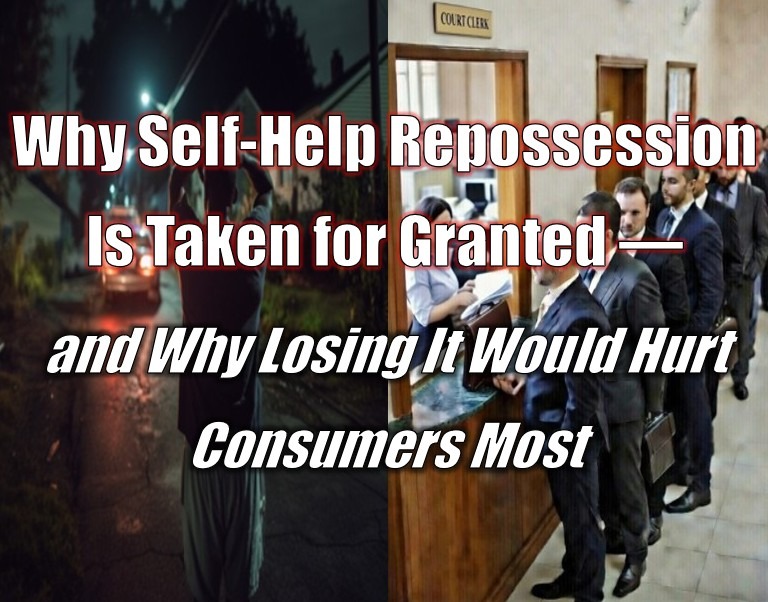
Why Self-Help Repossession Is Taken for Granted — and Why Losing It Would Hurt Consumers Most
Respectfully submitted,
Shane Freitas
President & Owner
Accurate Adjustments, Inc.
Concerned Repossession Agency Owner
Active in the repossession industry since 1988
Agency owner since 1997
Why Self-Help Repossession Is Taken for Granted — and Why Losing It Would Hurt Consumers Most – Why Self-Help Repossession Is Taken for Granted — and Why Losing It Would Hurt Consumers Most – Why Self-Help Repossession Is Taken for Granted — and Why Losing It Would Hurt Consumers Most
Why Self-Help Repossession Is Taken for Granted — and Why Losing It Would Hurt Consumers Most – Repossess – Repossession – Repossession Agency – Repossessor – Repossession – Auto Loan – Lending






More Stories
The Broken Bond Between Lenders and Agents – Positive Resolution
The Repos That May Never Come
A Repossession Is a Repossession
When “Partner” Is Just Another Word for Vendor
Welcome to the Repossession Casino — But Who Is Really Paying the Losing Bets?
The Cost of Doing Business: Why We Cannot Afford to Work for Free