
By Vaughn Clemmons, President, American Recovery Association
EDITORIAL
There is a developing story unfolding in Illinois, one that should concern every member of our recovery ecosystem. Several municipalities are now requiring repossession companies to pay to play. Agents are being charged fees simply to recover vehicles within certain jurisdictions. These small businesses are being strong-armed into paying local governments to conduct the very work they are already licensed, insured, and contracted to perform.
But it doesn’t stop there. Some municipalities have gone even further, mandating that agents leave written postings at recovery sites, explaining why the vehicle was removed and where it can be redeemed. Beyond being invasive and dangerous, such requirements may violate federal privacy and consumer protection laws.
And make no mistake, there is no escaping the long arms of these municipalities. In some areas, there are “watchers at the gate” who monitor tow trucks leaving recovery locations. If the municipality’s recovery fee hasn’t been paid, these agents are hit with heavy penalties and fines for simply doing their job. This is not regulation, it’s extortion under the guise of oversight. It targets small businesses that have neither the financial capacity nor the political reach to fight back. This is serious.
The Oxcart Permitting Model: A Growing Threat
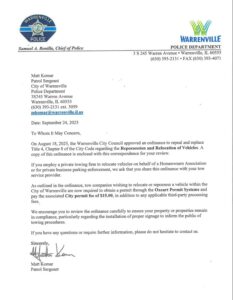
Oxcart Permit Systems is an online platform used by municipalities across the United States to manage local permitting for oversized, overweight, and towing-related activities. In Illinois, several villages and cities have adopted Oxcart to administer local towing permits including those now required for repossession activities conducted within municipal boundaries.
Under these local ordinances, repossession companies must purchase a towing permit through Oxcart’s online dashboard before or immediately after performing a repossession. These permits typically cost between $20 and $35 per tow, depending on the municipality. The stated intent, according to local officials, is to ensure accountability and record-keeping for towing activity within city limits.

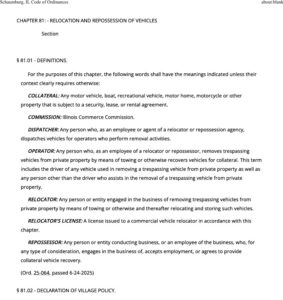
However, many of these ordinances go far beyond administrative oversight. Some include language that:
- Restricts repossessions from private or residential property, even when authorized under state law.
- Imposes mandatory notification procedures to local law enforcement before and after each repossession.
- Requires additional documentation or conditions not consistent with state-level repossession statutes.
In practice, several police agencies have used these ordinances to issue heavy fines or citations for minor administrative errors, such as a transposed digit on a license plate or VIN, a delay in police notification, or confusion over whether a vehicle was removed from private property.
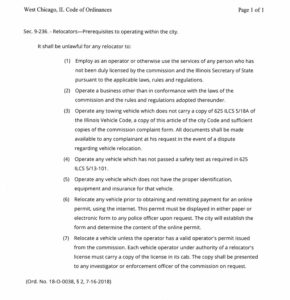
This growing trend has raised serious legal and constitutional concerns. Many industry professionals believe that these local ordinances conflict with the Illinois Collateral Recovery Act (225 ILCS 422) and other state laws governing repossession.
The Illinois Constitution limits local home-rule powers when the General Assembly has already enacted comprehensive legislation in a particular area, and repossession is one such area.
If left unchecked, these municipal permitting schemes could threaten the viability of lawful repossession operations across the state. Villages are already generating significant fine revenue from Oxcart enforcement, creating a financial incentive for more municipalities to join the program.
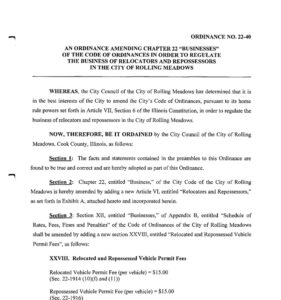
Oxcart currently operates in Illinois, Indiana, and Michigan, primarily for overweight and oversize vehicle permits. While Oxcart’s expansion into repossession-related towing permits is most prevalent in Illinois at this stage, industry leaders are warning that it could spread quickly into neighboring states if not addressed through legislative or association-level action.
Additional facts:
- Fine structure: $250 for the first offense, $500 for the second, $750 for the third, and $1,000 for the fourth.
- Repossession companies quickly reach the fourth level, forcing them to avoid those municipalities altogether, leaving lenders unable to recover collateral.
- Oxcart claims that fees cannot be paid by debtors, which means financial institutions and repossession companies are left to absorb the cost.
The Bigger Picture
Why does this matter? Because it’s spreading.
What began as a localized ordinance in one municipality has now surfaced in several states. And if left unchecked, this practice could sweep across the nation, quietly embedding itself into our industry until it becomes yet another accepted cost, as routine as “no storage fees.”
We’ve seen this movie before. Every time we tell ourselves, “It doesn’t affect us,” we inch closer to another unsustainable standard that chips away at our viability. Every time we remain silent, another municipality, another lender, or another forwarder finds a new way to exploit the recovery agent’s work and our silence becomes permission.
This is not an Illinois problem. It’s an industry wide problem.
And it will take the entire ecosystem, lenders, agents, forwarders, national and state associations to finally stand together and push back. This is not about politics; it’s about survival.
It’s about protecting the right to operate fairly, without arbitrary or punitive local barriers that serve no one but bureaucracies hungry for revenue.
As I prepare to hand over the presidency of the American Recovery Association, my hope and my prayer are that this moment becomes the crisis that unites us, not divides us. Let it be the spark that reminds us that everything matters, no matter how small it seems at first.
Because if we don’t fight when it’s small, we’ll find ourselves fighting when it’s already too big to win.
“If we don’t defend the ground we stand on today, we’ll wake up tomorrow wondering where the ground went.”
— Vaughn Clemmons

Vaughn Clemmons,
American Recovery Association
7750 N. MacArthur Blvd., Suite 120 -#321, Irving, TX 75063
PH: 972.755.4755, Fax: 972.870.5755 | www.repo.org

The Price of Doing Business and the Cost of Doing Nothing – The Price of Doing Business and the Cost of Doing Nothing – The Price of Doing Business and the Cost of Doing Nothing
The Price of Doing Business and the Cost of Doing Nothing – American Recovery Association – ARA – Repossess – Repossession – Repossession Agency – Repossessor – Repossession



More Stories
ARA Calls Industry Leaders to the Table Amid Historic Fuel and Operating Cost Pressures
The Broken Bond Between Lenders and Agents – Positive Resolution
The Fuel Emergency
The Repos That May Never Come
ARA Recognizes Westlake Financial Services for Increased Fuel Surcharge Support
A Repossession Is a Repossession